


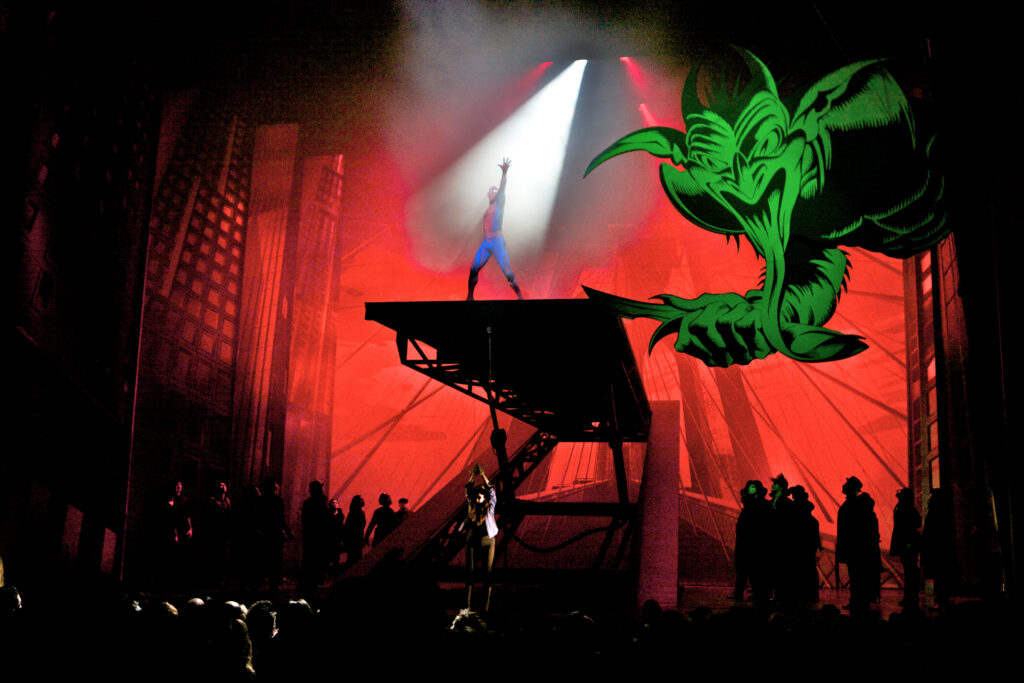
In Hawkeye, a fictional Broadway musical called Rogers depicted the life of Captain America and The Avengers. The show became so popular, that a real life version of Rogers had a brief run onstage in Disney California Adventure in the summer of 2023. The delightfully cheesy meta-moment brings back to mind the actual time Marvel tried to bring one of their superheroes to Broadway.
Spider-Man: Turn Off the Dark earned a reputation as being a train wreck of a production, suffering from a clashing creative team, a muddled story, and numerous injuries. It became known as being the most expensive Broadway show to flop in history, and having the longest preview period with a whopping 182 performances before actually opening. If Rogers was ever considered to become a proper musical, learning the mistakes of Turn Off the Dark might be a good way to avoid repeating history.
With Great Power, Comes Great Theatricality
Following the ginormous success of the first Spider-Man movie in 2002, Marvel looked for other industries to conquer with their iconic superhero. They approached Tony Adams, an Irish director, to produce a musical based on Spider-Man. Adams was best known for his work with Blake Edwards, worked on several Pink Panther films, and produced Victor/Victoria as a film and Broadway musical. Adams signed on, accompanied by his shadowing protégé David Garfinkle, an entertainment lawyer with aspirations to become a producer.
The duo would begin assembling a team to bring the musical to life. They hired Bono and the Edge of U2 to compose the numbers, supposedly inspired after Andrew Lloyd Webber made a joking comment about rock stars letting him run the theatre for twenty-five years. For director, Julie Taymor was brought onboard. Taymor had found huge success with The Lion King, applauded for her unique approach to the Disney classic, so it seemed certain the two-time Tony Award winner could bring the same visual gravitas to Spider-Man. The book would be co-written by Taymor and Greg Berger.
In October 2005, the key members of the creative team were getting ready to sign the contracts. The Edge stepped out to grab a pen, only to return to find Tony Adams on the floor, passing away from a stroke shortly after. It appeared Turn Off the Dark was doomed from the start, but David Garfinkle decided to go ahead with the production.
Bouncing Off the Walls
Although their key producer had passed away, the creative team pressed on for what would be an expensive and tumultuous planning period. Julie Taymor and Greg Berger crafted a complex script with a bonkers plot and even wilder stunts. Over twenty actions pieces were planned, with Spider-Man and the Green Goblin web-swinging, flying, and battling over the audience. Such a task would need a highly convoluted choreography plan, more finances, and a complete overhaul of the Foxwoods Theatre (now known as the Lyric Theatre).
Bono turned to Michael Cohl to become a new producer. He is a renowned concern promoter, whose resume including producing Spamalot and Hairspray. Yet, the musical’s budget continued to balloon, becoming $52 million by 2009, and then $65 million in late 2010. Garfinkel was booted out of the production, as Cohl and Jeremiah J. Harris of Live Nation took over production. The cast for the musical were announced, including Reeve Carney as Spider-Man, Evan Rachel Wood as Mary Jane Watson, and Alan Cumming as the Green Goblin. However, due to the repeated delays of the show, both Wood and Cummings dropped out, replaced by Jennifer Damiano and Patrick Page. Another important casting was Natalie Mendoza as the mythical Arachne, whose presence would weave many problems in the show’s story and creative direction.
Behold and Wonder
Early on, Marvel was much more involved in the development of Turn Off the Dark’s story, requesting that it draw inspiration from the ongoing Ultimate Spider-Man comic books. Julie Taymor’s own contract stated she had final say in every aspect of the production, including changes to the script and story. The first version of Spider-Man’s Broadway debut can be described as very comic book-esque in its approach, with an overcomplicated plot that favoured focus on removing what made Spider-Man special in favour of what feels like a metaphor of the show’s troubled production.
The first incarnation of the show’s story (also known as Version 1.0) is guided by the Geek Chorus, a quarter of hipster Spider-Man fans, who wish to plot out the ultimate story. The lone woman, G.G. (short for “Geek Girl”), decides that Peter does not gain his powers by chance, but instead by destiny, as decided by Arachne, the tragic Greek figure who was turned into the first spider by Athena. Peter delivers a school report on Arachne which is enough to inspire her to give him his powers, design his costume, give him the motivation to be a hero, and then wants to both marry and mate with him. The original three-page treatment for the musical mentioned that she would then eat him per a spider’s nature.
The first half of the play closely follows Spider-Man’s origin story and the events of the 2002 film. Uncle Ben’s tragic death occurs early on when he is run over by a carjacker, who Peter refused to stop, since the car in question was Flash Thompson’s. Meanwhile, Norman Osborn realises Spider-Man is the result of his genetic experiments, choosing to become a test subject, but it goes wrong, turning him into the wisecracking Green Goblin. He installs a piano on top of the Chrysler Building and kidnaps Mary Jane for fun. The Geek Chorus then decide that Norman gets tangled up in webs and his piano takes him on a fatal stage dive.
In the second act, G.G. decides that Spider-Man still has yet to fight his ultimate foe. Enter the campy Sinister Six, consisting of regulars like Electro, The Lizard, Kraven the Hunter, and Carnage, the underused Swarm, and G.G.’s own creation Swiss Miss, who looks like Witchblade gone wrong. The villains participate in what can be best described as a supervillain cat walk to vie for Spider-Man’s greatest enemy. However, Peter goes through his usual misery in life and quits being Spider-Man to be with MJ.
Arachne makes repeated attempts to draw Peter into the Astral Plane to get freaky with him, then outright takes over control of the plot from the Geek Chorus. How does that work? Mad that Peter isn’t interested or grateful for her gifts, Arachne has her minions steal shoes in a wacky musical number to woo him. The play then climaxes in Peter and Arachne facing off in what the script called a mating ritual, before the latter realises that Peter loves MJ, but is also kind and merciful towards her. This somehow allows Arachne to be free of her immortality, ascending upwards to the afterlife using the rope that she hung herself with in her legend.
There are some themes of the classic “with great power, comes great responsibility” and a take on theme of self-sacrifice from Spider-Man 2. Arachne wants to be vindicated and valued via Spider-Man’s triumphs, only to then grow angry when he doesn’t do as she wishes. It is a cruel irony, becoming enraged at a defiant mortal defying a god. Yet, Arachne’s presence essentially hijacks the whole musical, making Peter’s own story very superficial. The two characters don’t even meet until the show’s finale, Peter unaware Arachne was even real. Some suggested that both G.G. and Arachne were self-inserts of Julie Taymor, sidelining Spider-Man in his own musical to focus on a scorned, misunderstood female artiste.
The Stuntman Falls From the Sky
After years of delays and production woes, Turn Off the Dark finally started previews on November 28th, 2010. It should be noted that the cast and crew had only had one run through of the show beforehand. It was an absolute disaster. Dragged out for five hours due to technical failures, the audience suffered as the show fell apart before their eyes. Natalie Mendoza, cast as Arachne, was struck backstage by falling equipment, receiving a concussion. She would call it quits several weeks later, replaced by T.V. Caprio.
The show’s elaborate stunts were known to be ambitious and expensive. If one part of the system broke down or missed a timing, then it caused a ripple effect across the whole show. The aerial stunts were praised as a highlight of the show, but at least six people were injured because of them. The most infamous was that of stuntman Christoper Tierney, who played Spider-Man in crucial moments. On December 20th, Tierney took a leap off a high platform, only to realise he did not have a safety cord attached to his harness. He plummeted 21 feet, through the stage, and into the orchestra pit, fracturing his skull, though miraculously recovered. Previews were halted for safety reasons, slapped with safety violation fines by OSHA. That, and the creative cobwebs were being spun anew.
Pull the Trigger
By 2011, it was clear that the musical’s book wasn’t working. The producers hired Roberto Aguirre-Sacasa to rewrite the story. Aguirre-Sacasa was a budding playwright when he dipped his toes into writing for comics. His first play was actually about Archie, only for Archie Comics to send a cease and desist letter asking for the character names to change. Years later, Aguirre-Sacasa would go on to create both Riverdale and Chilling Adventures of Sabrina, and is the CCO of Archie Comics. In 2003, he was hired to write for Marvel, including for The Sensational Spider-Man. His involvement in his rewriting Turn Off the Dark proved to be the right call.
In the revised, Version 2.0 of the musical, the Geek Chorus were gone, Arachne’s role was downplayed to a supporting figure of wisdom, and Green Goblin became the main antagonist. A delightfully camp villain song, “A Freak Like Me Needs Company”, was added into the second act. Yet, Julie Taymor was incredibly protective of her story, supported by her contract, which allowed her to have final say on just about everything. She believed her story was more powerful and would resonate with audiences, though trying to choose one timeless story over another proved
Julie Taymor was eventually ousted out of the production by the producers, Bono, and the Edge, leading to a rather nasty series of lawsuits, disputes, and finger pointing. Philip William McKinley was brought in to serve as creative consultant and then director.
Rise Above
Despite all of the show’s flaws, Spider-Man: Turn Off the Dark actually managed to have a brief, successful run. From 2011 to 2014, the musical had over a hundred sold out performances, though interest waned. The expensive cost of the musical became its own worst enemy, becoming the biggest flop in Broadway history.
Not all blame can be placed on Julie Taymor. Bono and the Edge were on repeated tours, releasing new albums, and pursuing other projects during the show’s production, delaying the completion of its songs repeatedly. That, and they had no experience in creating musicals. The early death of Tony Adams, and the inexperience of David Garfinkle as a producer likely contributed to the creative clashes and lack of compromise between the various leaders. The technical web of the show made the show appear to be unchangeable, not without costing more money. Taymor’s reputation and career went into a tail spin afterwards. The cast would go on to have continued, successful careers, especially Reeve Carney, who would star in Hadestown.
The pile-up of financial struggles, a lack of collaboration, the accidents, and the public criticism may have doomed Spider-Man: Turn Off the Dark. It was clear that those involved did want to make a good show, but the hubris of those leading the way led to its downfall.
With great power, comes great responsibility, indeed.